Part II of a series exploring the art of Dr. Hans-Ulrich Roll, a German Naval officer interned in Canada during the Second World War. Missed Part I? Check it out here.
In early February 1945, Dr. Hans-Ulrich Roll arrived at Ozada, Alberta. The remote siding, some sixty kilometers west of Calgary, was bustling with activity as armed guards stood watch as two hundred POWs disembarked from a train. Transferred from Camp 44 at Grande Ligne, Quebec, the prisoners had spent the last several days on the train, traveling across Ontario, Manitoba, and Saskatchewan before finally arriving into Alberta. Now, stepping off the train, the prisoners were immediately greeted by a stunning view of the Rocky Mountains.
In short order, the POWs were loaded aboard a convoy of trucks and on their way to Camp 130 at Seebe. Originally Camp K (Kananaskis), Camp 130 was Canada’s first internment camp of the Second World War when it opened in September 1939 on the grounds of a government-run forestry research station and former relief workers’ camp. The first internees were German-Canadian civilians arrested and detained from across Canada but they were replaced by German Enemy Merchant Seamen (EMS) in November 1941. Then, in July 1944, the increasing number of POWs transferred to Canada after the D-Day landings prompted another shuffling of Canadian internment operations and Camp 130 was re-designated to hold German combatant officers.
Bordered by the Rocky Mountains to the West and foothills to the East, Camp 130 was a significant contrast to the internment camps the officers had left behind in Ontario and Quebec. Oberleutnant Josef Stahl, transferred to Seebe aboard the same train as Dr. Roll, described in a letter home:
The railway station is about 3000 ft. high; from it, we traveled to the Camp in trucks. The camp is surrounded by snow covered mountains; right at the edge of the wire the lowest ridge starts and looking at it, one has the impression one is looking at the Alps. Most of the mountains are covered until half way up with pines; the summits are bare. I must say the district is beautiful and I like it very much indeed here. I’m quite prepared to spend here the time I have to lose as a PW. Old inhabitants of the Camp say there are numbers of wild animals about such as horses, cougars, wolves, elk and bears. Perhaps I’ll see some soon.
Oblt. Josef Stahl to Johann Stahl, n.d. in Information and Intelligence Summary, February 1945, HQS 9139-4-130 – P/W Classification – Camp Intelligence – Seebe, C5365, RG24, LAC.

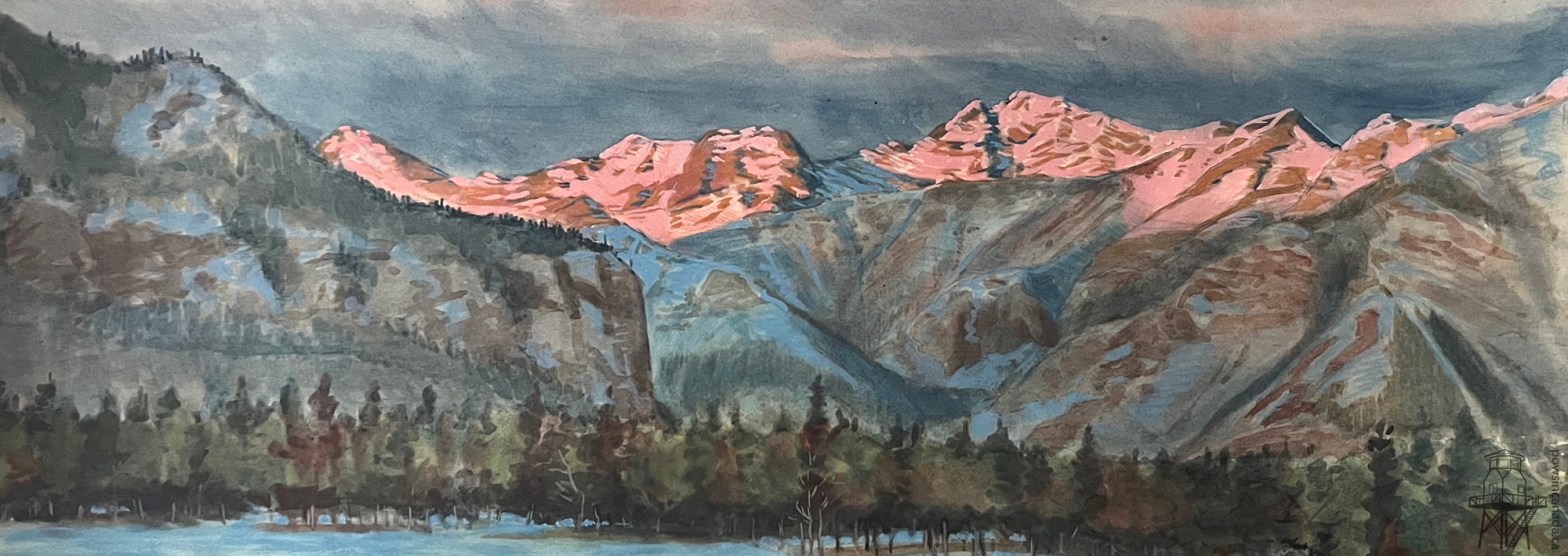
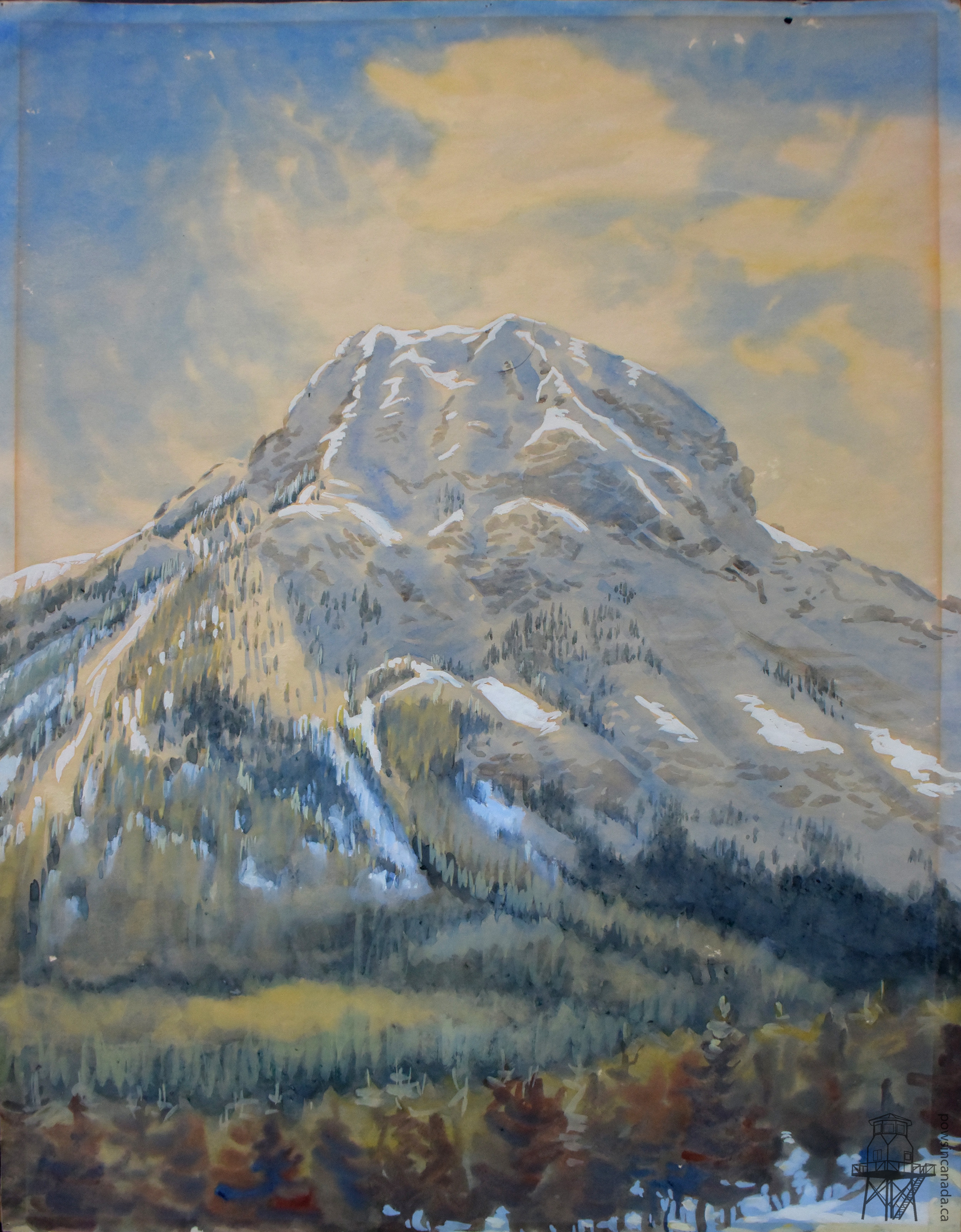
For landscape artists like Dr. Roll, the mountains provided a brand new, and seemingly endless, source of artistic inspiration. Towering over the camp was Mount Baldy, the most prominent peak near the camp and Dr. Roll captured it in at least one painting. Judging from the staining of being in a frame, I suspect it was one of his favourites.
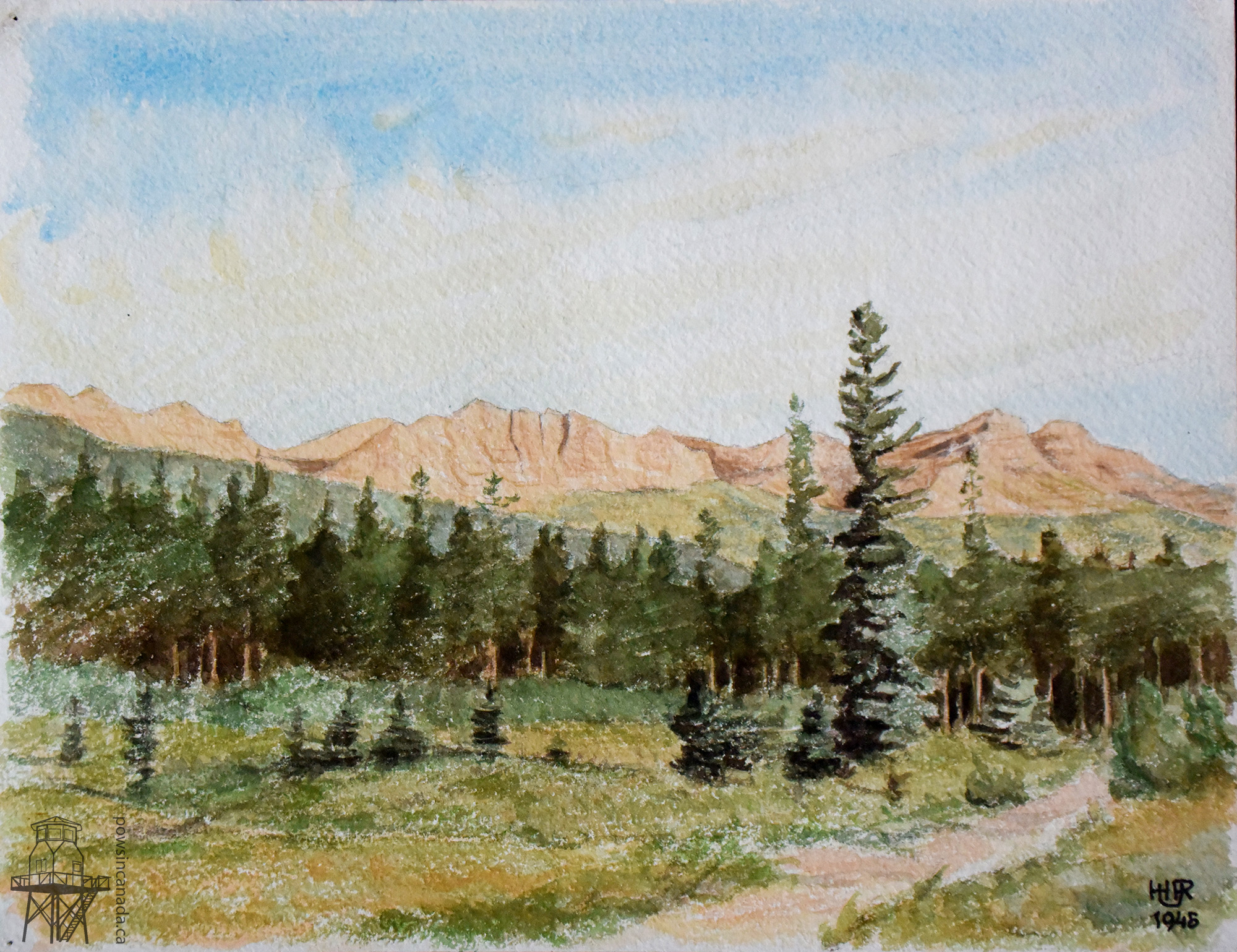
But Mount Baldy was one of many mountains visible from the camp enclosure and Dr. Roll did not limit his focus to a single peak. From within the camp enclosure, Dr. Roll captured several mountain vistas, including this one to the West of the camp.
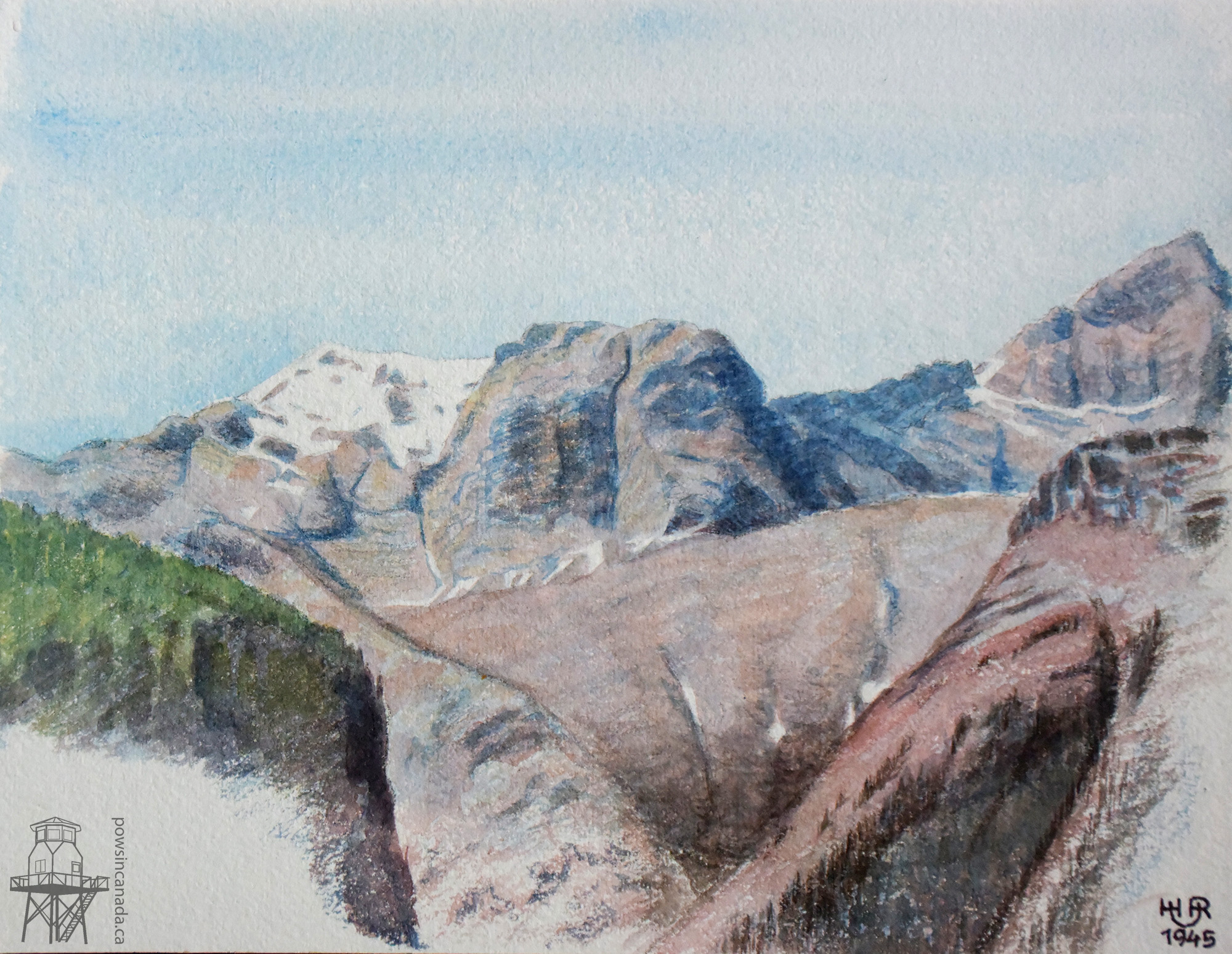
And, thanks to Google Streetview, we can see the same view taken in June 2021, seventy-six years to the month after Roll’s painting.
As Dr. Roll continued painting, in the Summer of 1945, camp staff permitted groups of up to sixty-five POWs to take parole walks – with a guard escort – in thea area surrounding the camp. Prisoners willing to go on these walks had to declare they would not attempt an escape and any violation would result in the immediate end of parole walks for all prisoners. As these walks were among the officers’ only opportunities for a brief respite from the confines of the barbed wire fences, the officers took parole seriously. The camp intelligence officer reported,
Walks are easily the most popular means of taking exercise at the disposal of the PW and there is seldom a day when the number going out is less than permitted. During the last week of July, a spot was found in the River Kananaskis where swimming can be permitted without the risk of the PW coming into contact with any civilians. The PW find the water at this altitude very cold and do not stay in long, but the dip appears to be very welcome and a request has been made to convert the ordinary daily walk into a walking-swimming party as a regular thing for the rest of the summer.
Information and Intelligence Summary, July 1945, HQS 9139-4-130 – P/W Classification – Camp Intelligence – Seebe, C5365, RG24, LAC.
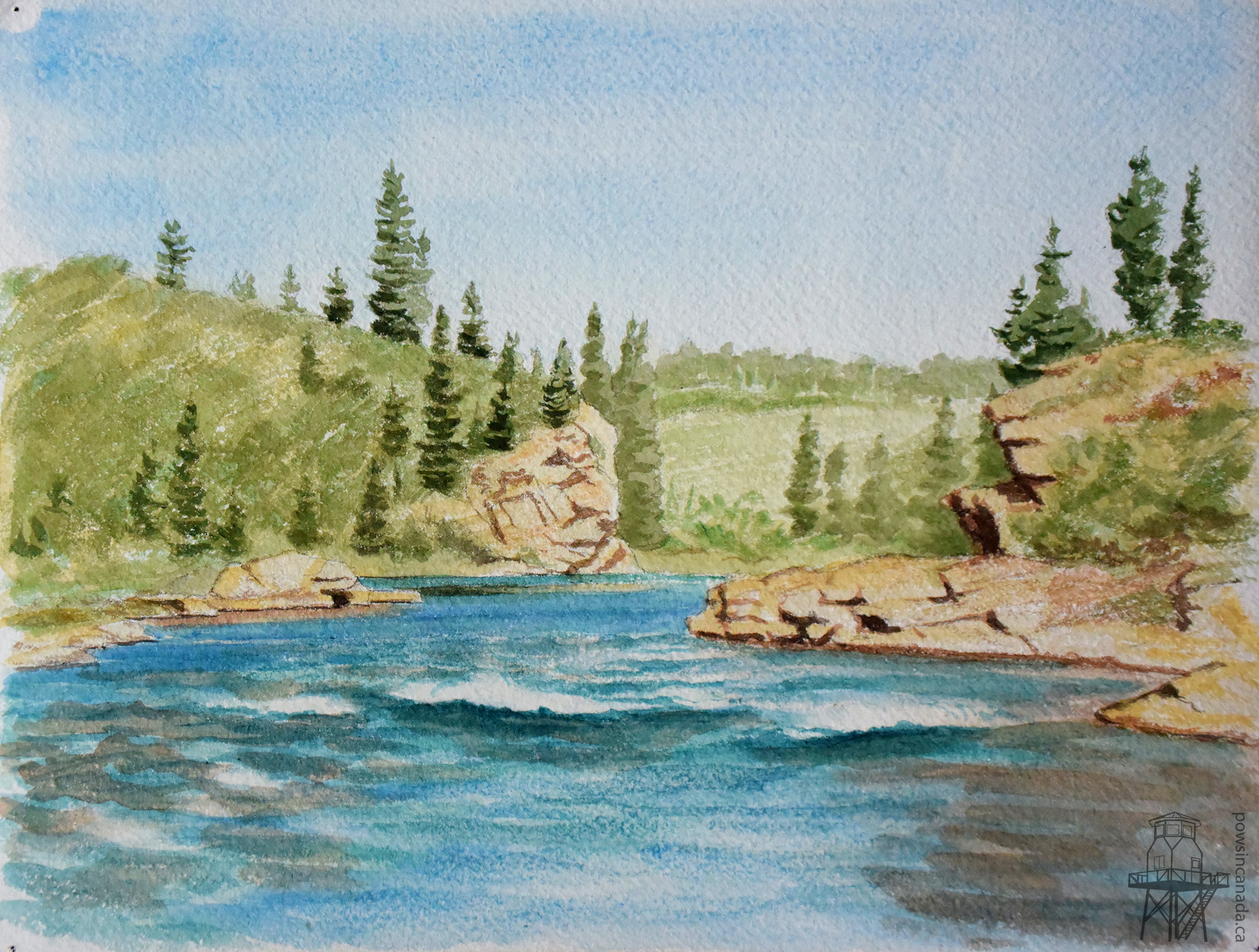
This next painting suggests Dr. Roll brought his art supplies with him on one such walk, likely sketching this small piece of the Kananaskis River in July 1945 where the POWs could swim in the cold waters of the Kananaskis River (which had not yet been dammed to form Barrier Lake).
Like other POW artists, Dr. Roll was not limited to the views in his immediate surroundings and instead occasionally took inspiration from external media. Photographs and other pieces of art circulating in books, newspapers, or films were reproduced and the next painting appears to be an example of such.
Depcting a mountain range near Canmore (and Banff), with Mount Rundle on the right, this painting was completed by Dr. Roll in August 1945. As neither he nor any of the other prisoners were taken near Mount Rundle, this was likely reproduced from another depiction of the mountain range. While some artists did so to expand their sources or develop their skills with new media or subjects, the practice was also spurred by artists diversifying their range in order to earn an income.
Japan’s surrender in August 1945 brought an end to the Second World War and, with it, came a reduction in prisoners’ service pay. The British government remained responsible for providing monthly service pay for German officers in its custody but, now that hostilities had ceased, service pay saw a significant reduction. Dr. Roll’s monthly pay, for example, dropped from $35.44 to $13.29.
In order to make up the difference, Dr. Roll and other POWs turned to art and handicraft, selling their work to the guards and camp staff through organized sales. Dr. Roll’s pay record indicates several sales of art between September 1945 and March 1946, earning him between $5.50 and $7.80 a month.
It may have been shortage of income or a shortage of art supplies in camp that resulted in this next mountain scene; rather than start anew, this unfinished snow-capped mountain scene is on the reverse of a painting Dr. Roll had completed at Farnham in June 1943.
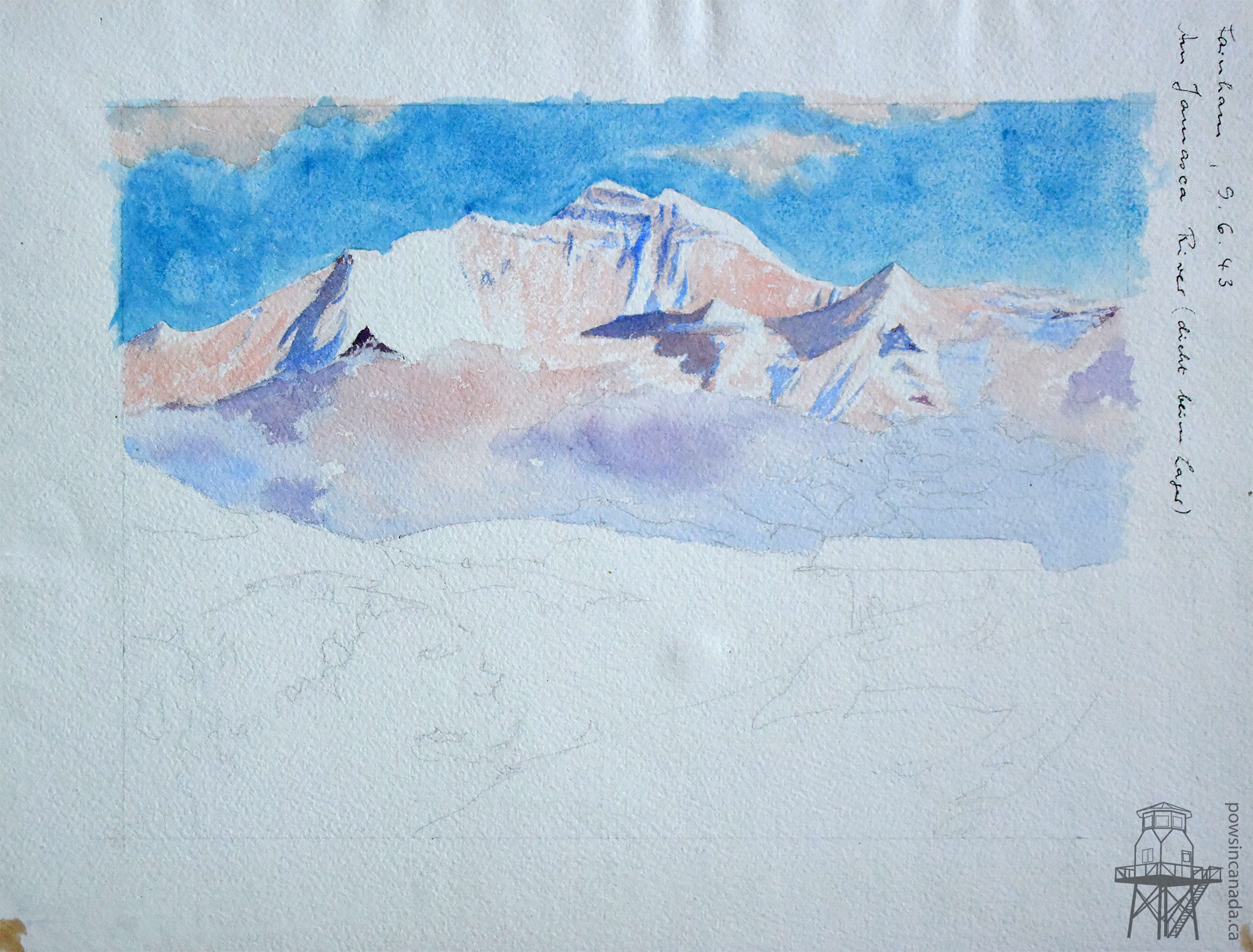
The mountains depicted are unknown, but may depict those behind Mount Baldy, visible to POWs potentially on a parole walk up the mountain. Regardless, mountains clearly captivated Roll’s attention and he continued sketching and painting them through 1946.
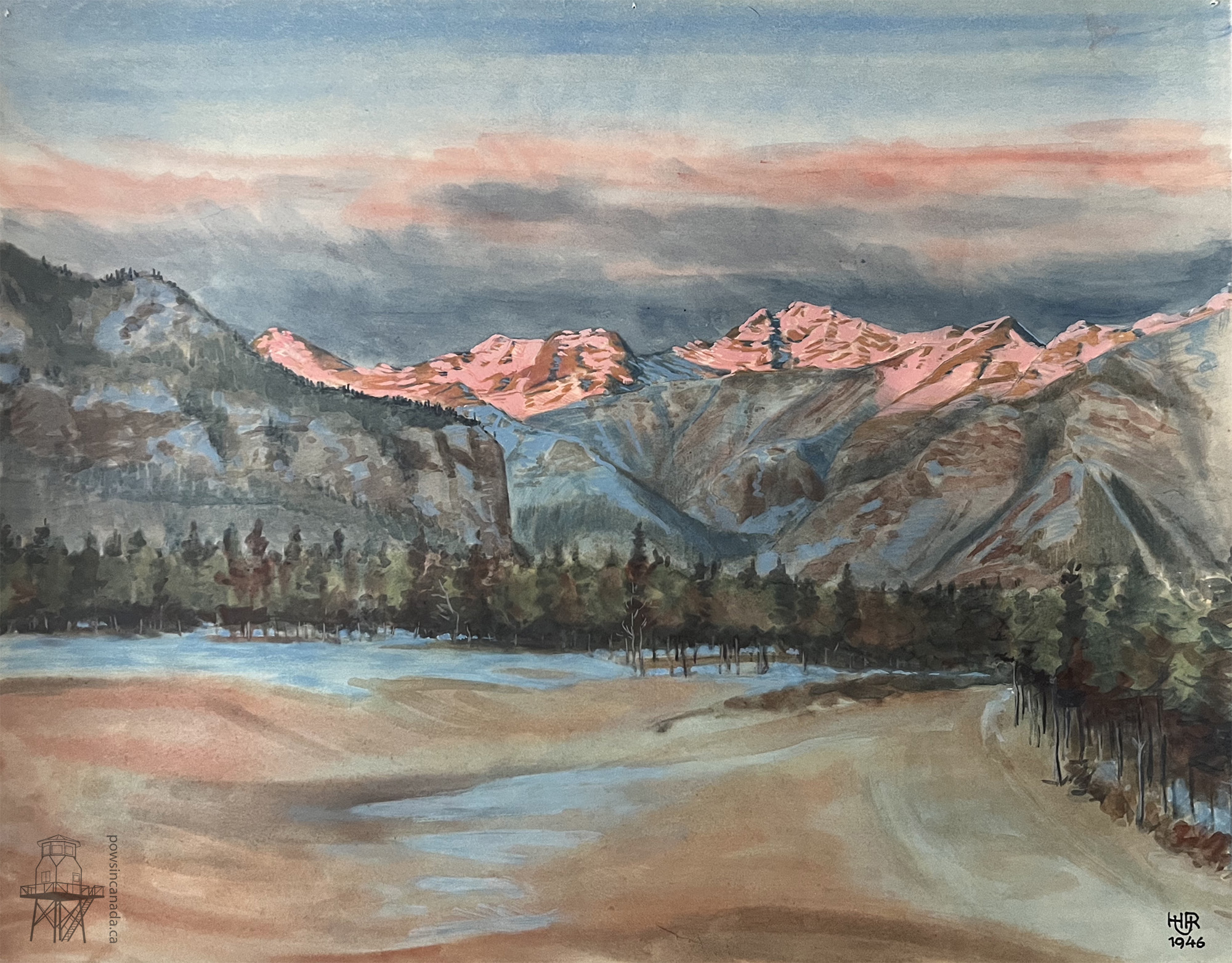
Once again looking to the West from the Camp, “Sonnenaufgang über den Rockies,” or “Sunrise over the Rockies” shows the view seen by prisoners from the Southwest corner of the camp. Typical of his work, Dr. Roll left no sign he was a prisoner of war and has omitted any indication that this view was likely seen through two layers of barbed wire fences.
In September 1945, the Calgary Power Co. had begun employing 150 officers on parole to clear trees from an area along the Kananaskis River in preparation of damming the river for a hydroelectric project. All of the officers in the camp volunteered for the work, which earned them $0.50 per eight-hour shift. The work continued into 1946 and, as the next painting shows, the prisoners cleared a sizeable area.
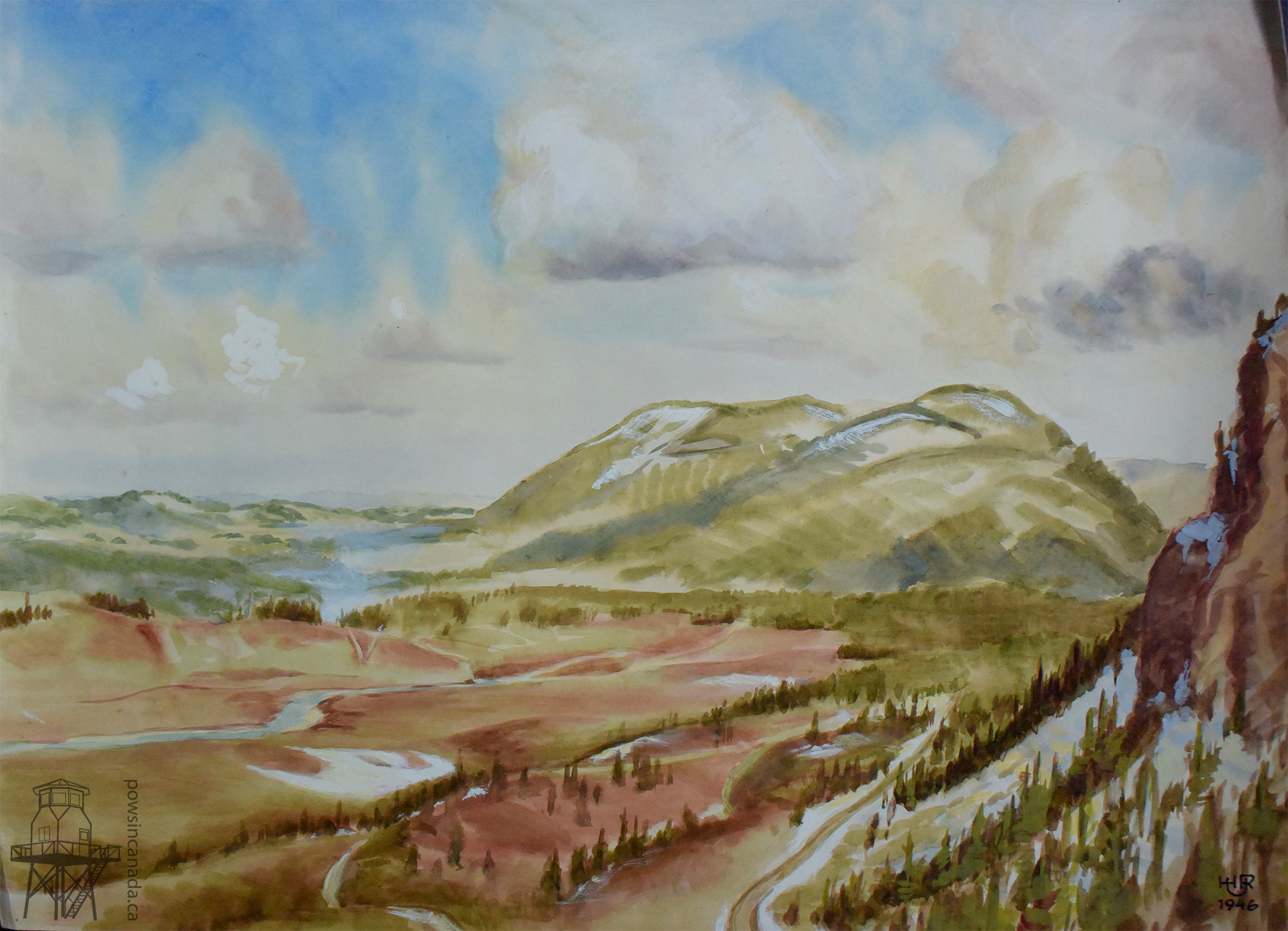
With the edge of Mount Baldy visible on the right, just obscuring Camp 130, a large clearing can be seen in the foreground – land cleared by the POWs since September 1945. The road winding along the mountain is the predecessor to Highway 40 and the clearing, now under several metres of water, is now the site of Barrier Lake.
These paintings were among the last that Dr. Roll completed while interned as a prisoner of war in Canada. In early 1946, Canada began preparations for transferring prisoners in its custody to the United Kingdom for their eventual repatriation to Germany. He, like most of the officers in Camp 130, received a P4, or “Black,” classification under the PHERUDA system in January 1946, suggesting he remained pro-Nazi. As the camp’s intelligence officer reported, the majority of POWs in Camp 130 held on to their beliefs despite the collapse of Nazi Germany;
Most of the inmates have been and still are staunch Nazis. A good many of them are professional soldiers and will be most reluctant to accept any position in life other than soldiering. The mental, moral, political and economical rehabilitation of these PW will be exceedingly difficult if not impossible.. Their is hardly any place in the new Germany for their particular talents, and thus they will probably continue to constitute a threat.
DMI, “Report on offer of co-operation by German PW Officers,” January 12, 1946, HQS 9139-4-130, C5365, RG24, LAC.
While Dr. Roll may not have changed his political opinions, his time at Camp 130 and Kananaskis provided a new source of inspiration for his art. Captivated by the mountains, his sketches and watercolours provide a sense of the daily views German officers interned in the foothills of the Rocky Mountains experienced. But, once again, any indication he was a prisoner of war remains absent from his work. Perhaps this is a result of his politics, a desire to resist his internment, or simply to leave it behind. I do not know. And although Dr. Roll was soon to be on his way to the United Kingdom, he was not done documenting his time in Canada.
Stay tuned for the third, and final part, of this series.


Thanks for sharingArt better than politics?Best DieterSent from my iPadOn Oct 20, 2026,
Michael
Did you get the copy of the POW card I have from Roll?. I sent it to
you just after your first article about him. If it did not arrive let
me know and I will resend it.
John Cranmer