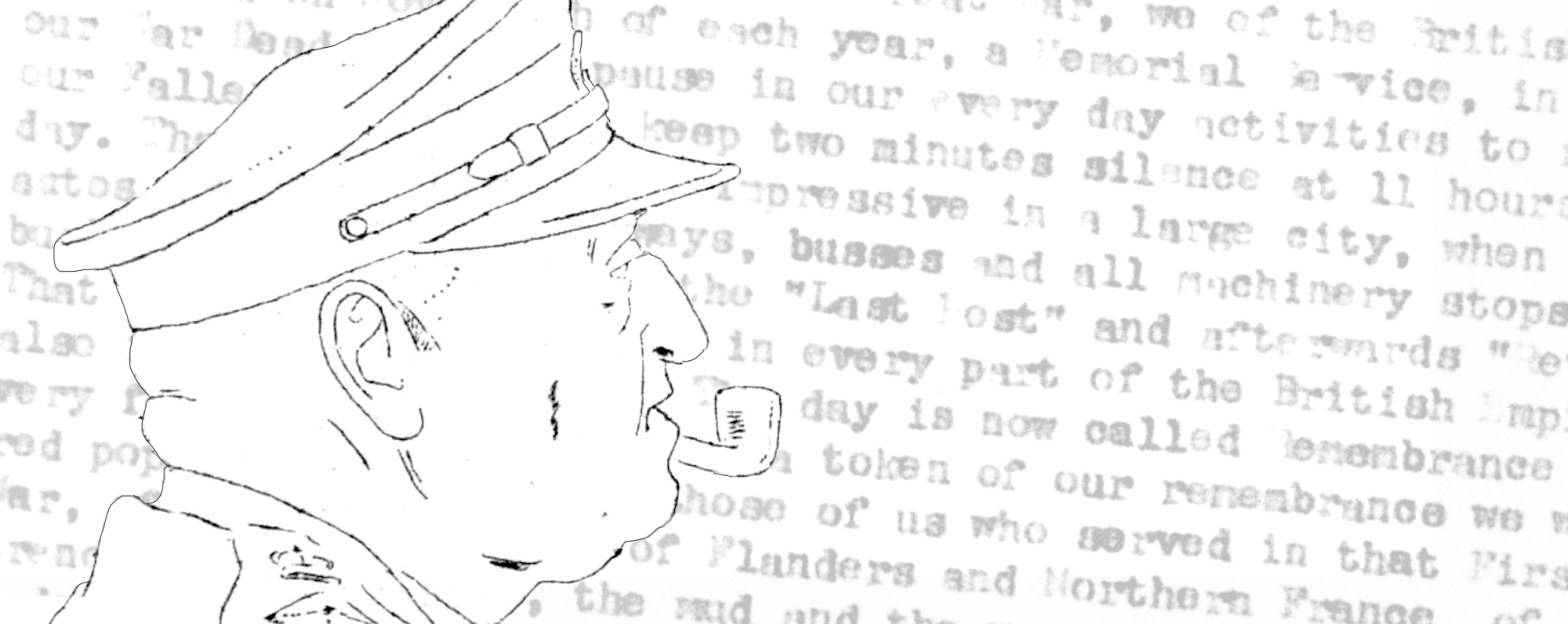
On November 10, 1946, the day before Remembrance Day, the German prisoners of war in Camp 133 (Lethbridge) held a memorial service to honour their dead. With the war over and most of the camp’s population transferred to the United Kingdom, the remaining 1,300 POWs in camp knew their time left in Canada was short. In a rare appearance, Camp Commandant Lieutenant Colonel William Charles Henry Pinkham took the opportunity to address the POWs directly. His speech follows:
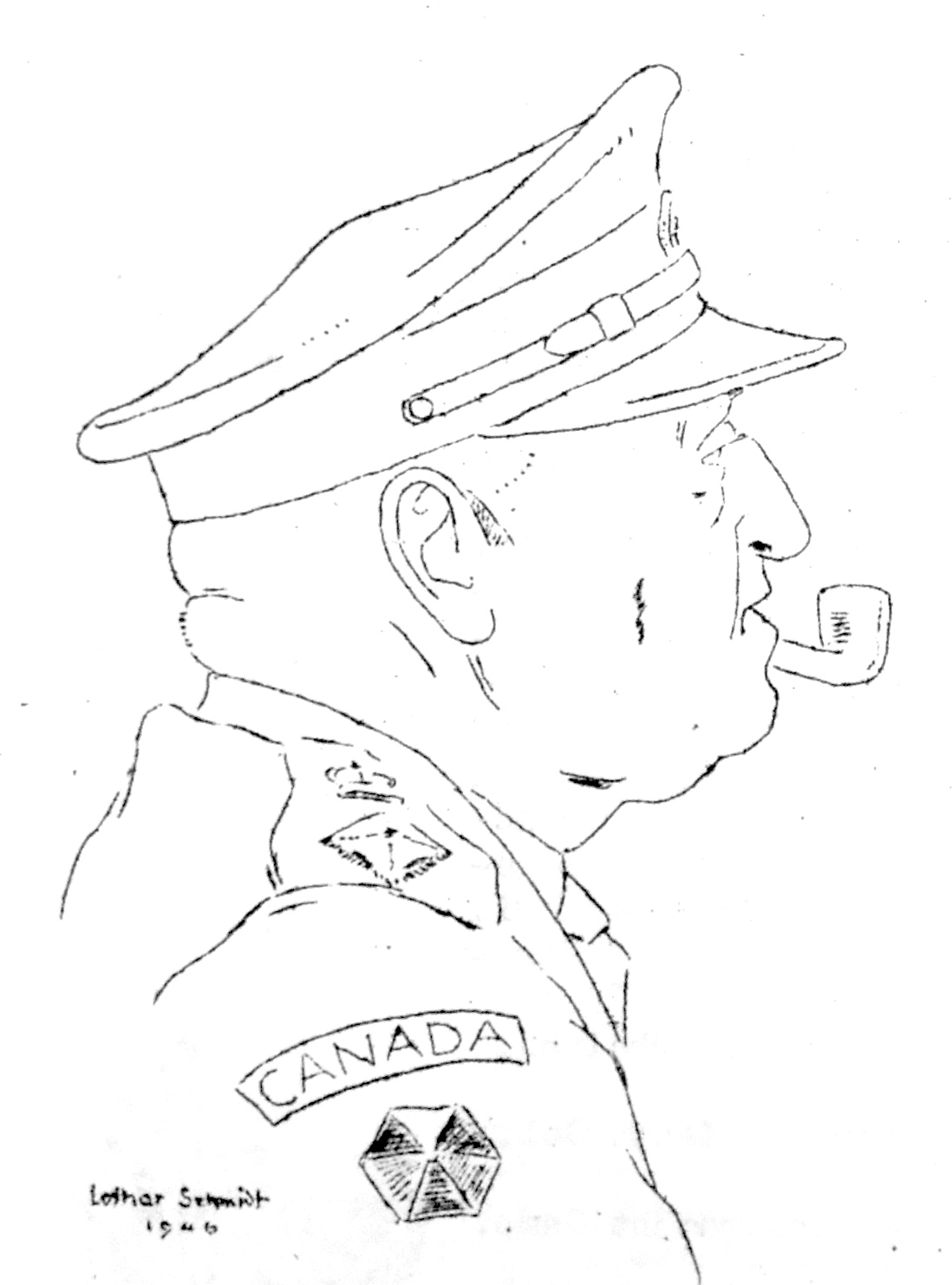
I have been asked to address you to-day and most of you, probably, for the first time during your captivity are seeing and hearing a Camp Commandant speak to the camp. My words will at least give you something new to think about, and, no doubt, to talk about, and that will be a change anyway from all the rumours that are constantly circulating among you. You are gathered here to commemorate and to remember your fallen comrades.
“Totengedenkfeier am 10. November 1946,” HQS 9139-133 – Classification – Lethbridge, C5367, RG24, LAC.
Ever since the end of the First Great War, we of the British Empire, have held on Nov. 11th of each year, a Memorial Service, in honour of our War Dead, when we pause in our every day activities to remember our Fallen Comrades. We keep two minutes silence at 11 hours on that day. That silence is most impressive a large city, when all traffic, autos, street cars, railways, buses, and all machinery stops. Then the bugles are heard sounding the ‘Last Post’ and afterwards “Reveille’. That simple Service is held in every part of the British Empire and also in the United States. The day is now called Remembrance Day. A very fitting name I think. As a token of our remembrance we wear a red poppy – a reminder of those of us who served in that First Great War, of the Battlefields of Flanders and Northern France, of the trenches, the dugouts, the mud and the wreckage of war, of fine comrades, good soldiers and brave men.
They shall not grow old
As we, who are left, grow old.
Age shall not weary them
Nor the years condemn.
At the going down of the sun and in the morning
We will remember them.
You will note that we do not make this a day of rejoicing, but rather one of solemn contemplation. I well remember that day, Nov. 11 1918. My battalion was marching towards the fighting line near Mons, in Belgium, and I was marching at the head of my Company. We were excited because of the many rumours about the war ending and we were due to attack the next morning, the 12th, and were moving forward to our positions. Then came the message that all fighting would cease at 11 hours. We could hardly believe it. Then we cheered and told the people of the village through which we were passing. They, at first, could not grasp it, then they went almost mad with joy, shouting and screaming and crying. We could hear the roar of the guns, the chatter of machine guns and rifle shots, and, as eleven o’clock drew near, we kept looking at our watches, for we were afraid, I think, that the guns might not stop firing, that the message was false.
Then, suddenly, as though someone had used a switch to turn off the noise, there was a great silence. It felt as though all the world had stopped moving. We strained our ears, listening for more firing, but as the minutes passed and no shots were heard, we knew, at last, that the war was ended.
Now we have lived through another one and you have your own experiences to think over and talk of. Have you ever thought of our asked yourself ‘Why am I still alive when so many of my comrades are not. They were good soldiers and braver than I. They why was I spared?’ I asked myself that question after the First great war and I have always felt that the answer was, that there was still something for me to do. It may be big or it may be small, but still – something. How are you, each one of you, going to answer that question? Is there something for you to do in the years to come? Most certainly there is. The majority of you are young men in good health and strength, with normally a good many years of life before you. What are you going to do with those years? It is your life that you have to live, with its joys and sorrows, its successes and failures. No one else can live it for you. You owe it to yourself, to your loved ones, to your country, to your fellowmen, to do something – something that is good. What is past, is past, you cannot recall it. Bitterness about being a PW, about losing homes or loved ones, will not help you. Bitterness will twist your mind, will make you narrow minded, will make you sour, will make you lose your friends, will prevent you doing that something good, which you have been spared to do. What is that something? Is it to improve yourselves in your work, whatever that may be? Is it to work hard to take care of aged parents, to provide homes for your families? Is it to comfort the sick, to help those in need, to be a good neighbour? Who knows! The opportunities for any or all of these things will be yours in the future. They are, in a way, a challenge to each one of you. Are you going to be big enough men to accept that challenge? This, I can assure you, that unselfishness, self sacrifice, a willingness to help others will give you a greater feeling of satisfaction, a greater pleasure, than all other things put together.
Why were YOU spared?
There are no intelligence reports or notes to suggest how the prisoners reacted to Lt.-Col. Pinkham’s speech. Most of these POWs would leave Camp 133 for the United Kingdom within the next month and eventually return to Germany some time in 1947. While Pinkham’s message emphasized the feelings and questions that many of the guards and camp staff – now in their second war – had faced in recent decades, his address was also one final step in the process of denazifying POWs in Canada.
For the last year and half, Canadian authorities had began a systematic process to dismantle pro-Nazi control in camps across the country, to re-educate POWs, an to introduce a democratic way of life. By calling upon the POWs to make the most of their lives and with a challenge to be better, Pinkham hoped for a brighter future. We can only hope they accepted this challenge.
Lest we forget.
 POWs in Canada
That’s excellent and timely, Michael. Good find. Let’s not ever forget. Bernie