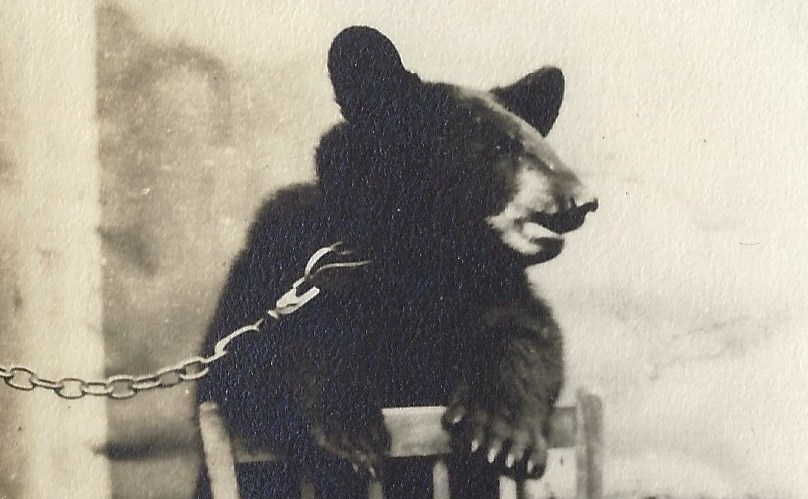
As I’ve mentioned in previous articles, POWs in internment camps and labour projects throughout Canada adopted, kidnapped, and acquired through various means an assortment of domesticated and wild animals and kept them as pets and mascots. Camp 100 at Neys was no exception. Here, POWs found themselves a black bear and photos, such as the one below, have appeared in multiple publications and even in the park’s visitor centre. The bear was always identified as “Nellie.”

But here is the problem: there was no bear named Nellie at Camp 100. Nellie was the pet bear at Camp 23 at Monteith. So who was this bear at Neys and why the mixup? After a few years of searching, I finally found the answer.
After Neys Provincial Park was established in 1965, Ontario Parks was eager to gather information about its POW past. The park’s first – and only (to date) – comprehensive study of Camp 100 was impeded by restricted on military records so Ontario Parks had to rely primarily on interviews conducted with former guards, POWs, and locals to piece together the site’s history. One such interviewee noted, “The Germans at Neys use to wrestle with Nellie. They would put boxing gloves on her.” “Nellie” thus became the bear’s apparent name and all later mentions of her being at Neys can be traced back to this interview.
While I was aware of there being a rather famous pet bear named “Nellie” at Camp 23 (Monteith), it was not until 2016 that I discovered evidence suggesting the bear at Neys went by a different name.
In October 1942, Dr. B. P. Spiro and Dr. Jerome Davis – both representing the War Prisoners’ Aid of the YMCA – began an inspection tour of internment camps in Ontario and Quebec. Arriving at Neys on October 14, Spiro and Davis toured the camp, focusing on the prisoners’ opportunities for recreation and learning. And, in one simple line, Spiro states:
We also paid a little visit to the bear cub ‘Mischka’
Dr. B. P. Spiro, “Report – October-November, 1942,” B1984-0014/001 (09) – Davis Reports 1942-43, Boeschenstein, Hermann Fonds, University of Toronto Archives.
And there it was. Mischka.
But this was only once source. And for six years, I searched for another source to corroborate Spiro’s report. And finally, in October 2022, I finally found it: three photographs and handwritten captions from the album of a former EMS or civilian internee interned at Neys.
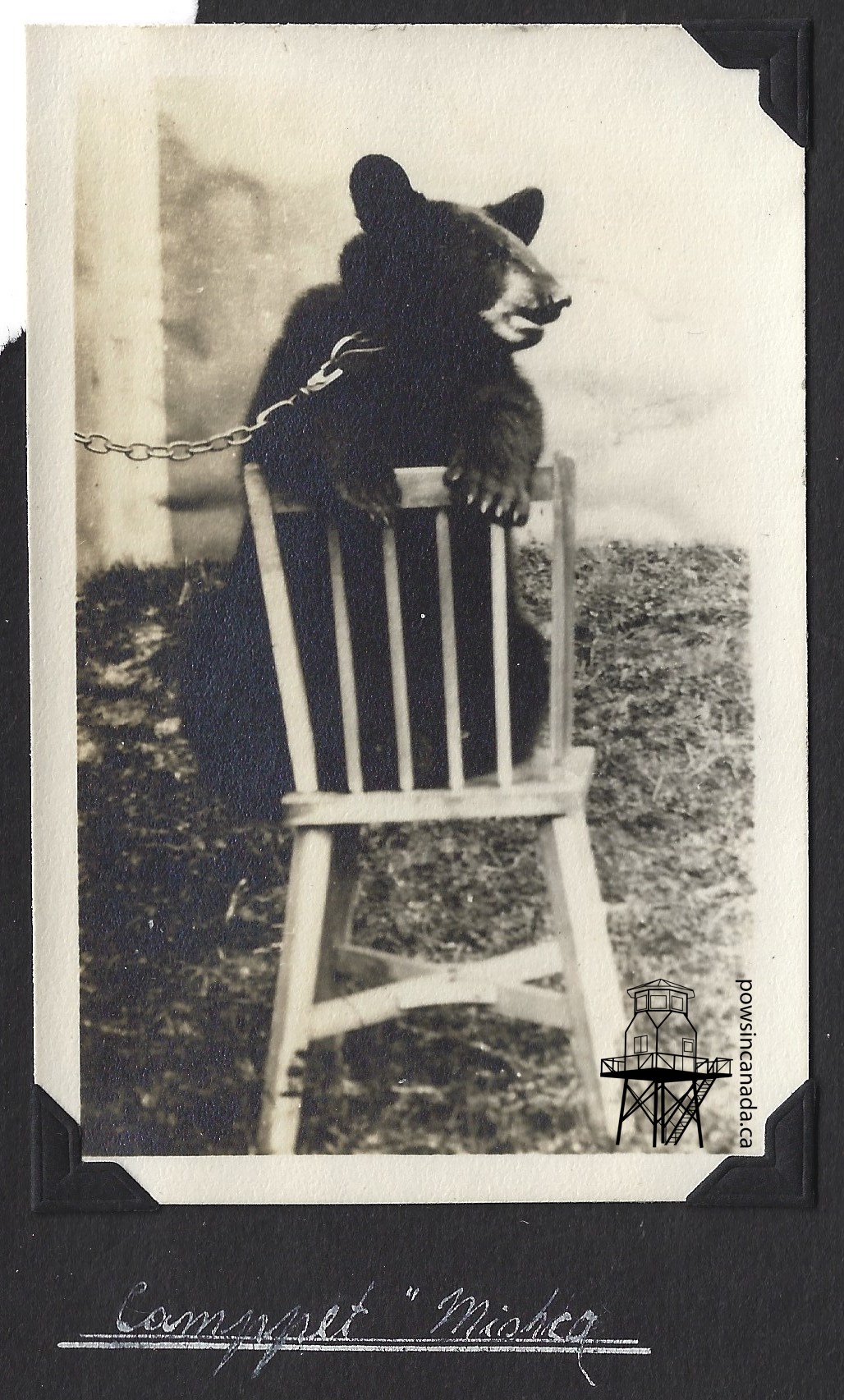
There it was, “Camppet ‘Mishca'”. Although there’s no consensus on the spelling, Mishka is Russian for “bear”.
Thanks to photographs from another former internee, Rudolf Müller, I know that Mischka also had a caretaker, thirty-two-year-old Enemy Merchant Seaman Max Wadephal (also Wadephol/Wadephul/Wadepfuhl), who had been captured aboard the Poseidon in October 1939. While the extent of his duties as caretaker are unknown, he is seen in several photographs “walking” her around in and around the enclosure.
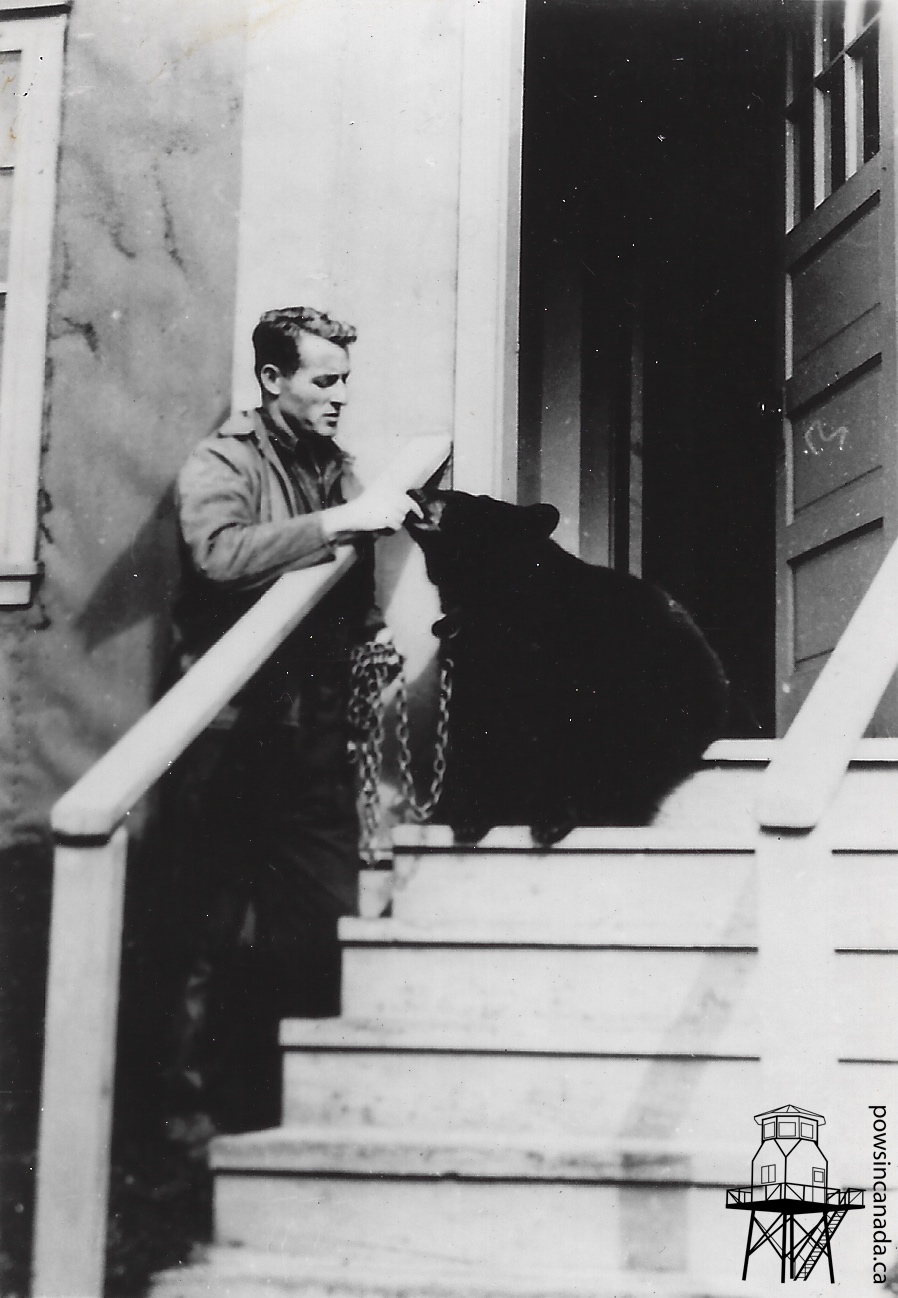
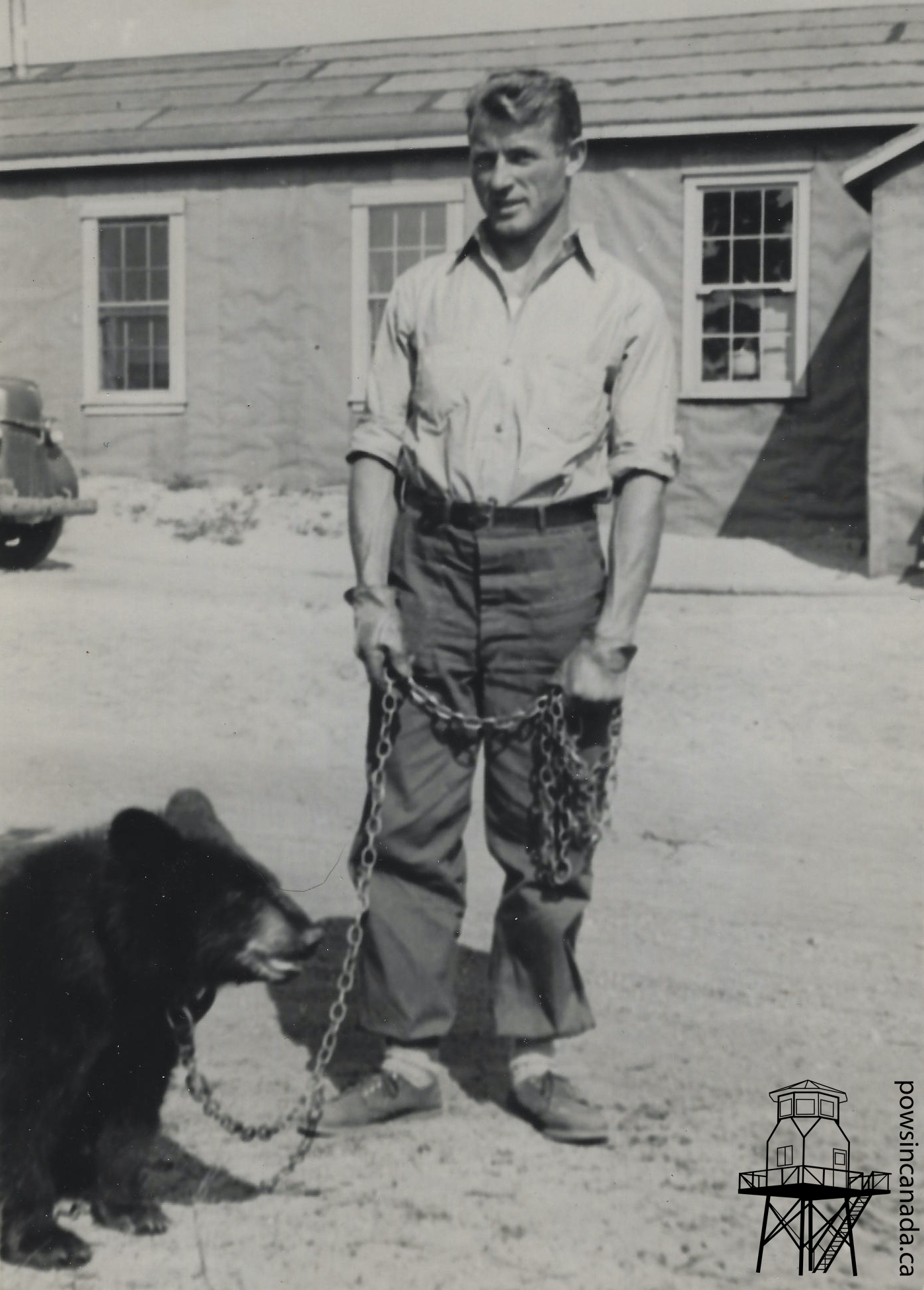
Mischka’s origins remain unknown. Was she “captured” by POWs on a work detail outside the camp? Did she wander into the camp bounds one day? Or was she was gifted to the camp by an aid organization like Nellie was to the POWs at Camp 20 (Gravenhurst)?
Her fate also remains unknown. When Camp 100 temporarily closed at the end of 1943, some POWs were transferred to the Pigeon Timber Co.’s bush camps further inland while the remainder were transferred to other internment camps. As there is no evidence to suggest she was moved with the POWs, I suspect Mischka was released into the wild but she simply disappears from the historical record.
Hopefully more of Mischka’s story will come at a later date but for now I am content to finally confirm her name. And with the support of the staff at Neys Provincial Park, Mischka’s name is being added to the park’s programs and displays.


Regretfully, the bears in particular were unsuitable to turn back to the wild, and woud not
have survived under natural conditions after their close contacct with humans within the camps.
After the PoW left the Vamp Site, the beasrs were humanely shot by a VGC member assigned
to the job. (No Zoo was interested in them).
One VGC member living at Red Bay, ONY. had a bear hide brought home from a Camp site. I
do not know the details of the bear. Most bears around a camp were considered to be a nuisance, and were shot on sight.
I believe my grandfather ran this camp Neys 100. I have photos of the camp. My mother lived there as a small child.