
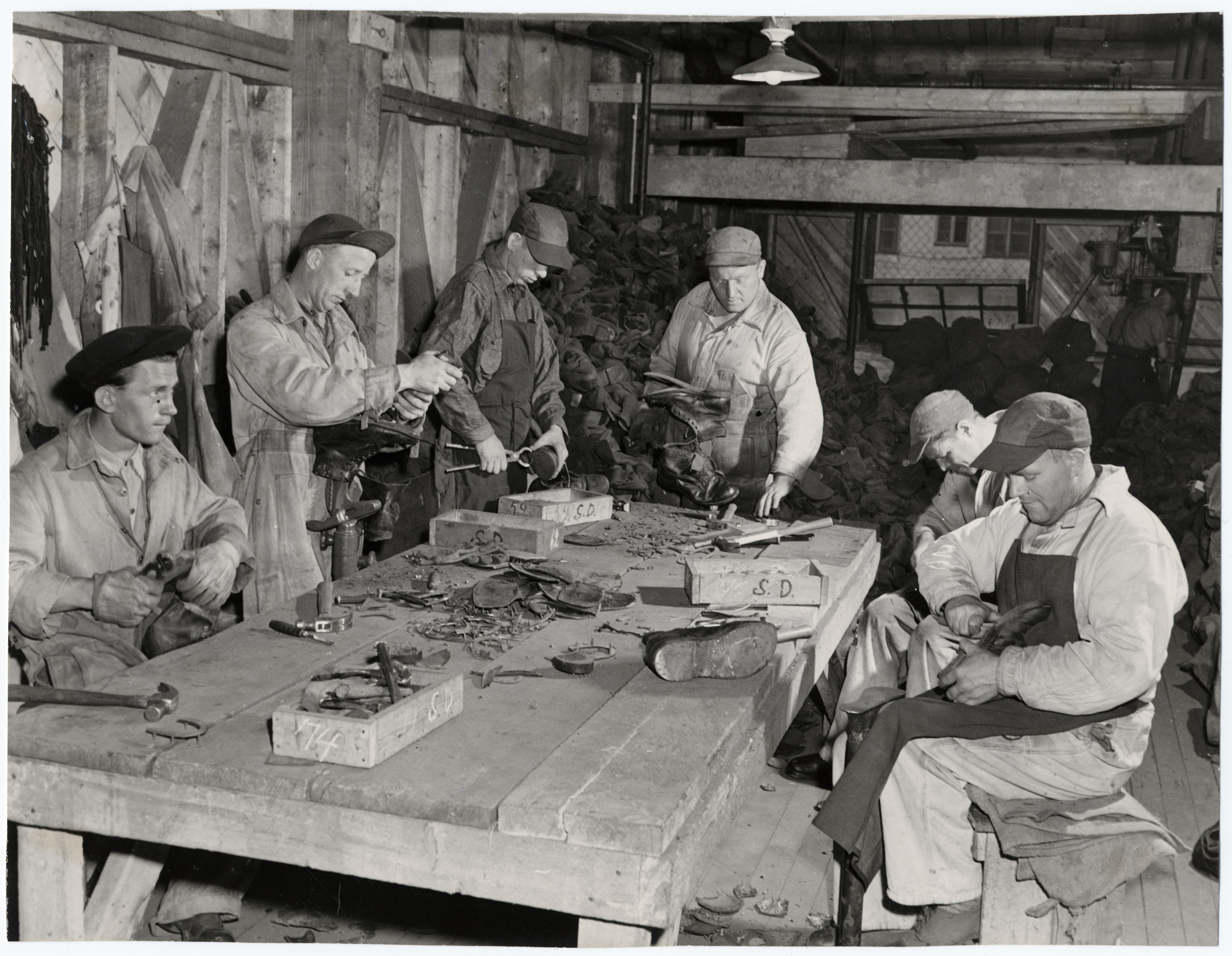
In December 1944, the Camp 42 (Sherbrooke) workshops were in full swing. Three years prior, most of the Civilian Internees and Enemy Merchant Seamen in camp had started working under the auspices of POW Works Programme, an organized effort which employed non-combatant POWs in light-manufacturing in accordance with the 1929 Geneva Convention. At Sherbrooke, this entailed the production of articles like wood crates, camouflage netting, and handcarts in addition to sewing, knitting, and shoe repair. But, in late 1944, the internees at Camp 42 were about to add a new product to their production line: toys.
In the weeks leading up to Christmas, a Canadian newspaper circulating through camp featured a story indicating there was to be a toy shortage this year. Several internees saw this as an opportunity to help and volunteered to make toys. They quickly received the permission of Camp Commandant’s Lt.-Col. Harold Douglas Hedley and set to work. Making the most of the workshops’ equipment and a ready supply of scrap lumber, the POWs busied themselves with toy-making in their free time and, within a few weeks, produced an array of toys including “movable animals, model ships, and carved figures.”
With the help of the camp staff, the toys were offered to the local Canadian Red Cross Branch, which happily accepted the donation and arranged for the toys to be distributed to the less fortunate. The donation remained anonymous and the toys remained void of any markings – only the internees, the camp staff and a handful of Red Cross Executives were aware of the their origins.
The program achieved such success that there remained a surplus of toys after the Red Cross took “all that they could handle.” Rather than see them go to waste, Camp Spokesman Alfred Pauli requested the Commandant’s permission to distribute the extra toys to some of the children who lived near Camp 42. Although the POWs had no real contact with the civilian population, they had frequently seen children while outside the enclosure on supervised walks. Lt.-Col. Hedley agreed and invitations were sent out to the local children, including several children of camp guards’ and staff.
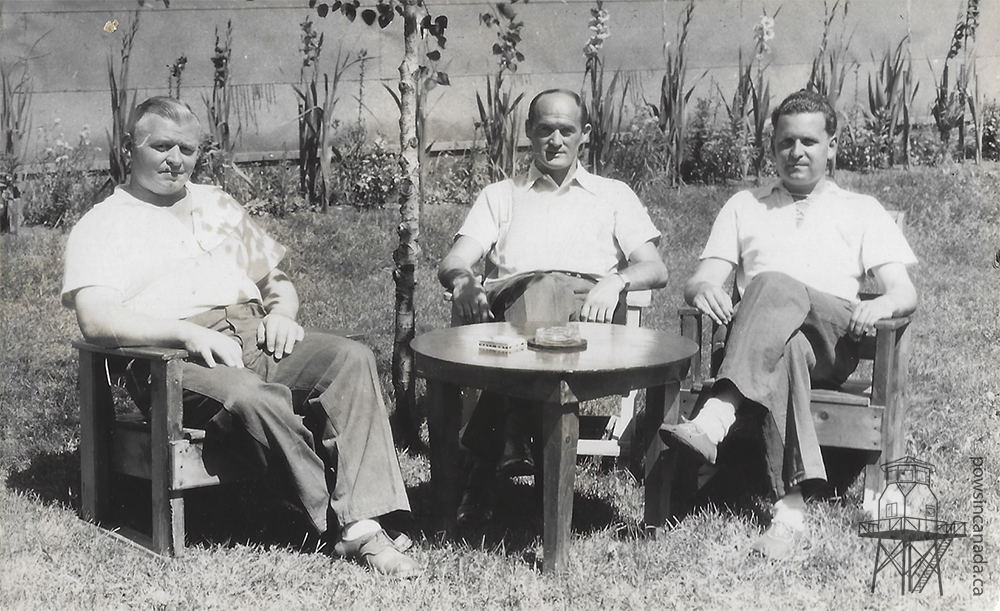
Müller Photographs, Author’s Collection.
Sometime near Christmas, the children and their families gathered in the Guard’s mess for the party. Willy Franz, an internee in the camp, described the event in a letter home:
Translation of letter from Willy Franz to Erika Heitmann, January 12, 1945, HQS 7236-32 – Camp N Sherbrooke, C5379, RG24, LAC.
Shortly before Christmas several hundred toys, mostly of wood, were made by a few comrades in this camp. Most of the toys were placed at the disposal of the Red Cross and distributed by them among the children of the neighbouring village. Some of the toys, boxes, ships and a swing were given to the children living near the camp. I was allowed to take part in this distribution. I decorated the table in the soldiers mess, a tree was decorated and our orchestra played carols. On the table there was an abundance of biscuits and cakes which we ourselves baked, and German candies. Thirty Canadian children arrived, all sizes, accompanied by their mothers. They came to us, to the German, the enemy. There were not very shy, as they had seen us on our walks during the summer months, and had accepted chocolates and candies from us…. On leaving I filled the pockets & small hands with candies & I made up a parcel for one very large family.
I cannot describe my feelings, it sounds so cold in writing, but during that very short hour my heart was very warm.
As Franz’s letter suggests, the event proved a success. The POW orchestra provided entertainment while a handful of POWs served as waiters. Contact was limited between the POWs and the civilians, with the Commandant noting a language barrier between the two groups. The sentiment, however, was abundantly clear. And, separated from their own families, perhaps POWs like Willy Franz found some solace in bringing joy to families.
The work of these POWs did not go unnoticed for Dale Brown, an employee of the War Prisoners’ Aid of the YMCA, noted in his annual report:
One of the finest expressions of the Christmas spirit of which I think I have ever heard, was the effort on the part of a group of German prisoners to make toys for the poorer children in the community adjacent to their camp. For several weeks before Christmas they spent their spare time from the works program making use of scrap pieces of wood to make mechanical and acrobatic toys of all sorts. When they were finished they had about 200 to turn over to the Red Cross for distribution. Such an expression of goodwill on the part of enemy prisoners is indeed a hopeful sign for the future.
Dale D. Brown, “Report on Educational Activities in Canadian Prisoner of War Camps, October 1 to December 31, 1944,” n.d. 621-J-40C – Visits by Swiss Consul General to Internment Camps in Canada, Vol 2760, RG25, LAC.
A hopeful sign indeed.
Happy Holidays and Merry Christmas!
 POWs in Canada