
Dates Operational:
– May 1944 to November 1944
– May 1945 to November 1945
– May 1946 to November 1946 (as a farm hostel)
Capacity: 325
Type of POW: Enemy Merchant Seamen, Civilian Internees, and Combatant Other Ranks
Description:
In an attempt to provide much-needed labour for the struggling agricultural industries, the Canadian government approved the use of POW labour in May 1943. A pilot program employing small numbers of POWs from Camp 133 on farms in the Lethbridge area proved promising but the Department of Labour wanted to also expand the program to southwestern Ontario. With no internment camp in the area suitable for providing the necessary POW labour, the Department of National Defence elected to establish a temporary, tented internment camp southeast of Chatham.
Using the same site that previously housed Japanese-Canadian internees, Camp 10 at Chatham was erected in Spring 1944 and ready for occupation by May. As a temporary camp, POWs and guards alike were housed in tents, with larger tents used for kitchen and dining facilities. Security remained a primary concern so the enclosure was still surrounded by barbed wire fences and guard towers.
For the summer of 1944, the camp housed German Enemy Merchant Seamen (EMS) and civilian internees from Camp 23 (Monteith) as they were deemed lower security risks than their combatant counterparts. Farmers could either drive to Camp 10 and pick up one or more POWs for the day, returning them to camp that night, or, if large groups of POWs were needed, farmers arranged for them to be driven to the farms for the day.
Working eight-hour days for 50¢ a day, the prisoners were used as general farm hands. Most worked on sugar beet farms, thinning and blocking the beets in the Summer and then harvesting them in the Fall. Others found themselves working corn, tobacco, and tomato fields; picking apples and peaches; canning tomatoes; and a small party even worked at the Wallaceburg Sugar Refinery.
At the end of the 1944 harvest, the camp closed for the winter and the POWs at Camp 10 were transferred back to Camp 23 (Monteith) or to work in bush camps in Northern Ontario.
The program’s success and an ongoing labour shortage prompted the reopening of Camp 10 for the 1945 season. In addition to the Chatham camp, the Department of Labour also opened small farm hostels – each housing 100 POW labourers – at Centralia, Glencoe, and Fingal to make POWs available to more farmers. Operating as satellite camps from Chatham, these hostels worked in the same manner as Camp 10 and, with the exception of Fingal, also housed POWs in tents.
The Department of Labour preferred employing EMS and civilian internees, but shortage of these men prompted the addition of combatant POWs to Chatham and its farm hostels. Despite employing “higher risk” prisoners, the program once again proved successful and agricultural representatives continued to receive applications for labour as the farming season closed. With no civilian labour available, the Department of Labour agreed to place selected EMS on individual farms for the winter.
With POWs expected to remain through the winter, the Department of National Defence still needed a camp in Southwestern Ontario to administer those POWs working on farms in the area. As the Chatham camp was only intended to be temporary, the Department of National Defence elected to use recently vacated No. 4 Bombing and Gunnery School at Fingal. As most of the POWs at Chatham were transferred to other camps, the camp staff and some 200 POWs moved to the new Camp 10 at Fingal.
While the Chatham camp was no longer an internment camp, it reopened in May 1946 as a farm hostel to continue providing local farmers with POW labourers. At the end of the 1946 season, the Chatham hostel was dismantled and it was once again turned to farmland.
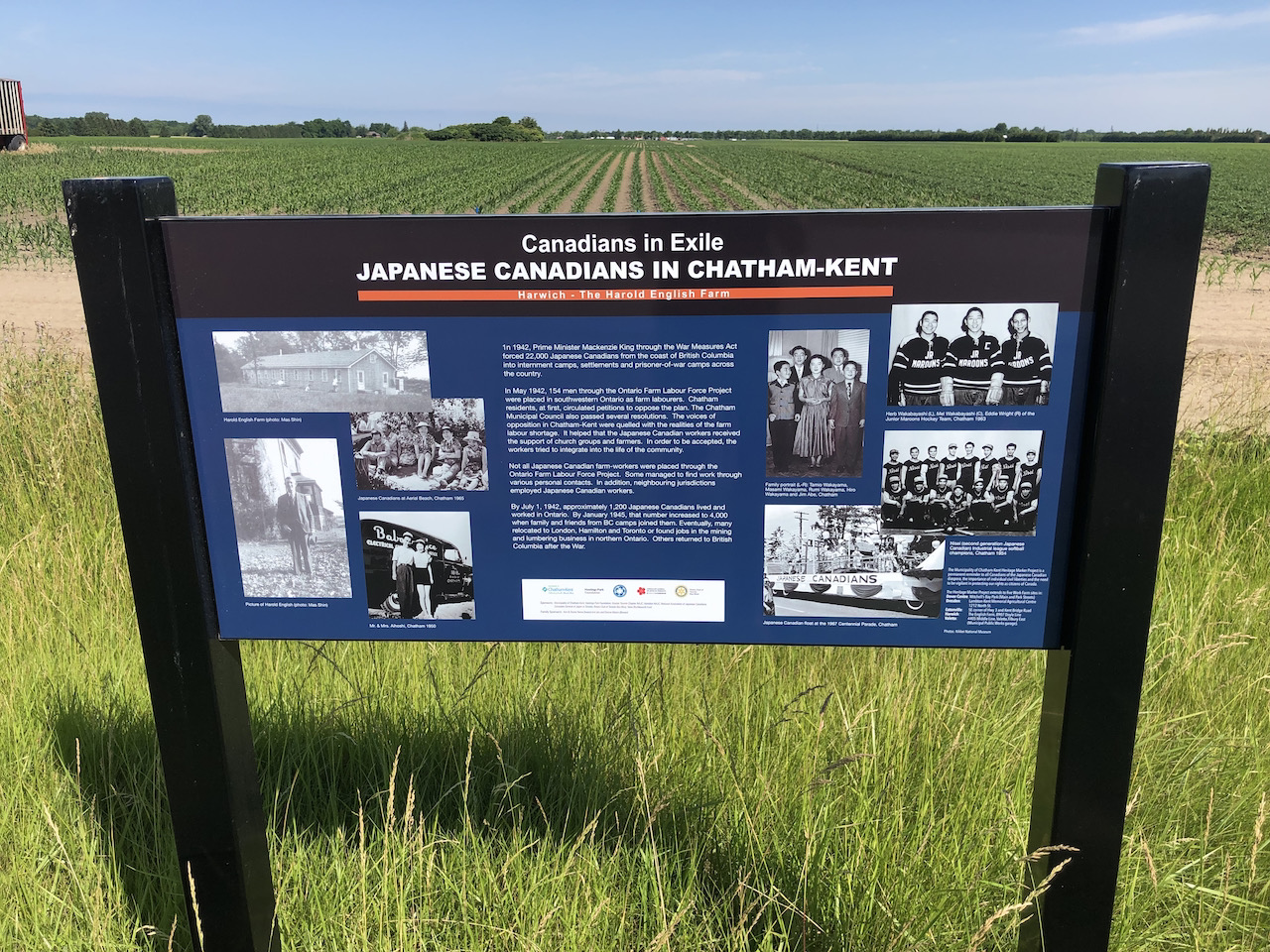
Today, a sign alongside the highway explains the history of Japanese-Canadian labourers in the Chatham area but it makes no mention of the site’s POW past.
Location:
Pictures:
Further Reading:
- Posts about Camp 10 (Chatham)
- O’Hagan, Michael, “Beyond the Barbed Wire: POW Labour Projects in Canada during the Second World War” (2020). Electronic Thesis and Dissertation Repository. 6849.
https://ir.lib.uwo.ca/etd/6849
 POWs in Canada