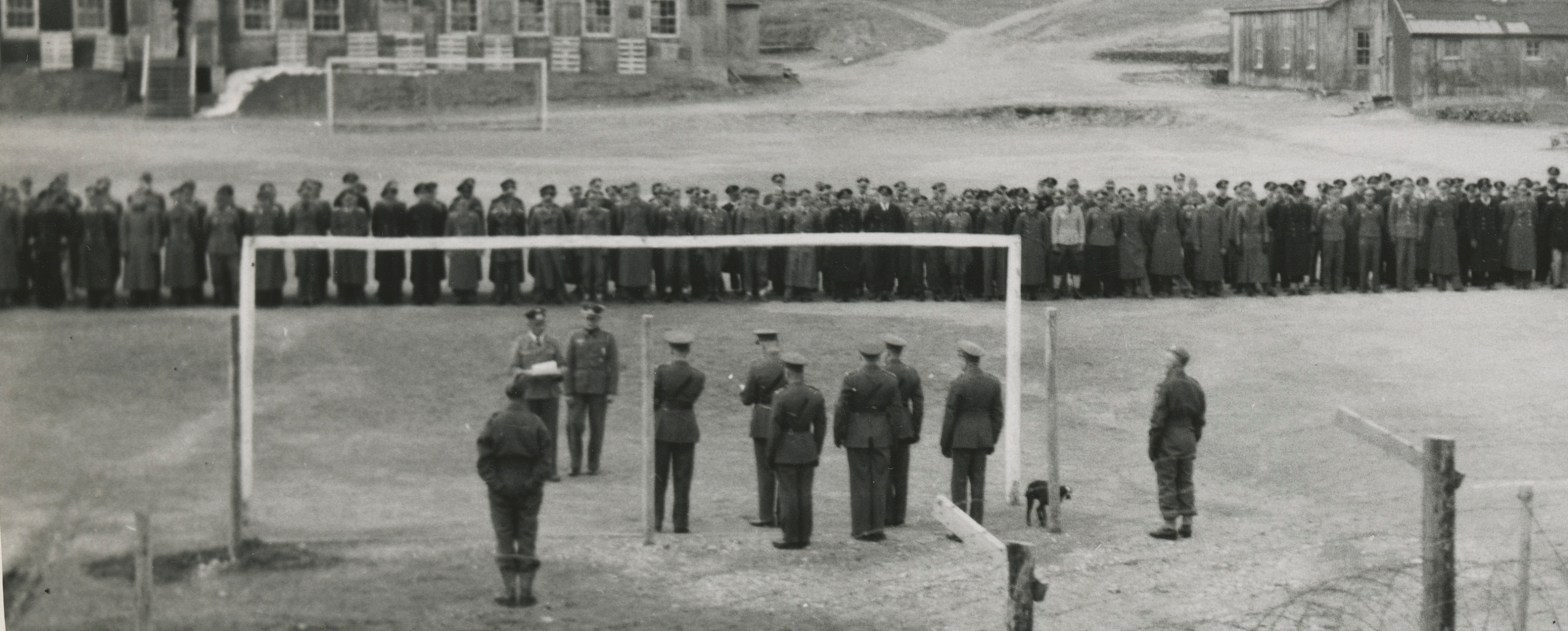
In the morning of May 8, 1945, Camp 130 Spokesman Generalleutnant Artur Schmitt, Assistant Spokesman Oberstleutnant Hans J. Brehmer, and their interpreter, Major Werner Gauthier, walked through the main gates and were escorted into the camp office. Here, they entered the office of Camp Commandant Lieutenant-Colonel Hugh de Norban Watson to await the news they had all been waiting for.
Generalleutnant Schmitt was in charge of the German Army, Navy, and Air Force prisoners at Camp 130 in Kananaskis. Originally built to hold German-Canadian civilian internees, Camp 130 had been home to German officers and a smaller number of other ranks since July 1944. But these officers had been sent to Kananaskis because they had been classified as “Black,” or pro-Nazi.
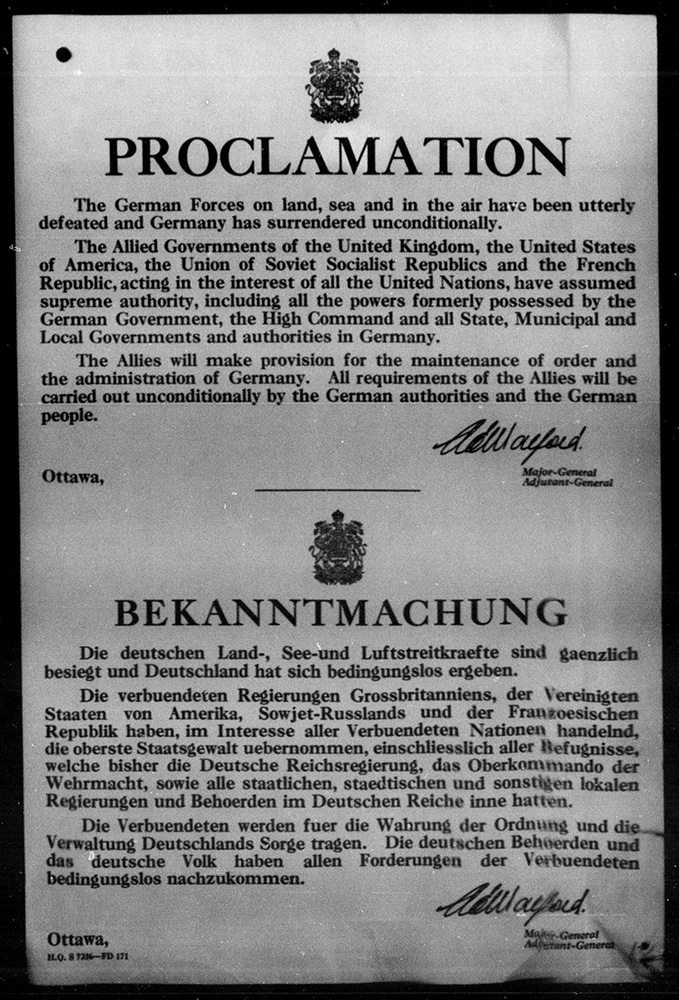
With the three Germans standing before him, Lt.-Col. Watson explained that he instructions to read a document entitled “Proclamation” to them. As Watson began to read the single page, he confirmed their suspicions: their war was over.
The German Forces on land, sea, and in the air have been utterly defeated and Germany has surrendered unconditionally.
Divided into an English and German version, “Proclamation” announced Germany’s unconditional surrender. After Watson finished reading the English half, Gauthier read the German version aloud to ensure there was no mistaking it – the war in Europe was over. The German officers made no comments, but Watson later reported that Schmitt took the announcement “hard.”
Watson then instructed Schmitt to have his men parade in the enclosure for the official announcement.

In short time, the prisoners in Camp 130 assembled in the parade square. Then, at 10:30 a.m., Commandant Lt.-Col. Watson entered the enclosure accompanied by members of his camp staff where they were met by Schmitt. Watson addressed the POWs through the camp translator, informing them he had been instructed to read the “Proclamation.” Watson then proceeded to read the announcement in English and, once he was done, the camp translator read the German translation.

The prisoners gave little reaction to the news and although Watson expected Schmitt to make an announcement, Schmitt simply dismissed his me after the Canadian officers left the enclosure.
After the enclosure gates closed behind them, Watson and the camp staff joined the rest of the camp guards for a short ceremony at the camp’s flag.

Here, Watson confirmed the news and, as the picture below indicates, the news was taken in a much different manner than in the enclosure.

The rest of the day proceeded without incident and, as Watson described, the prisoners gave little reaction:
Even bearing in mind that the PW have seen, for some time past, that Germany had lost the war and that the end was only a short time off, they appear to have taken the actual confirmation of their defeat surprisingly calmly. The daily program was not altered because of the news… A number of PW walked around yesterday morning with very serious faces but during the afternoon they appeared to recover their spirits and there were three football games played… The POW were excellently behaved and gave absolutely no cause for complaint.
Lt.-Col. H. de N. Watson, May 8, 1945, HQS 7236- C5365, RG24, LAC.
There was really only one thing on the minds of everyone in camp, prisoners and Canadians alike – Germany’s surrender meant they were all one step closer to going home.
 POWs in Canada